
Kentucky Can Spur Economic Growth and Resilience With Changes to Incentive Programs

9 Dec 2025
News
Kentucky has an opportunity to create brighter futures in counties with the highest rates of unemployment and poverty, while simultaneously making it easier for the state to rebound from economic shockwaves. Kentucky currently has a two-tier system for economic development tax incentives. If it expands to a four-tier model, it can better allocate resources to the counties that need resources most.
Through the proposed plan, which One East Kentucky President & CEO, Colby Kirk, presented to Kentucky’s Interim Committee on Economic Development and Workforce Innovation, annual reviews of tier placement will ensure any county affected by business closures has immediate access to resources, allowing them to rebound faster.
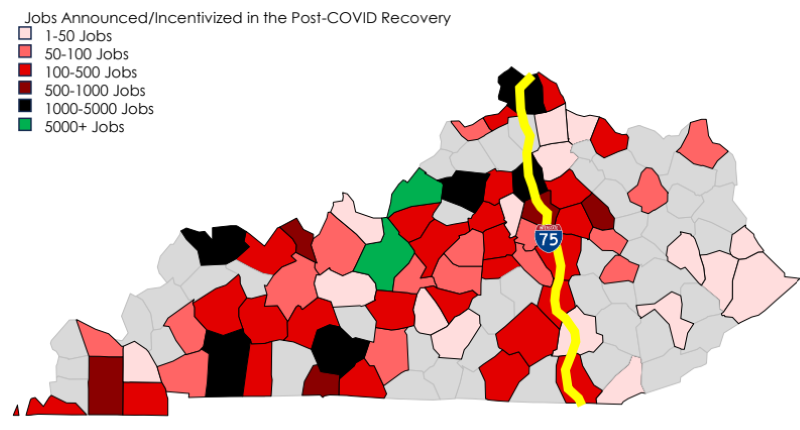
“Since the COVID-19 pandemic, 95% of all new jobs incentivized in Kentucky have been in communities along or west of I-75,” says Colby Kirk, President and CEO of One East Kentucky. “That leaves only 5% of incentivized job creation in 40 counties in the Eastern part of the state, where 16% of residents live.”
Kentucky lawmakers have an opportunity to support the entire state while specifically investing in regions with low median household income and high unemployment levels. Reducing poverty will benefit every resident, regardless of location and financial situation.
The Current Incentive Strategy is Inefficient
Kentucky has a two-tier system for economic development tax incentives: enhanced and non-enhanced counties. The enhanced counties allow companies to receive incentive benefits for five additional years. However, 90 Kentucky counties are currently enhanced, which is 75% of the state. This doesn’t separate the communities with the highest need levels from their more affluent counterparts, and is a contributing factor to why most post-pandemic job creation has occurred in wealthier areas.
A Four-Tier System is Detailed and Responsive
The team at One East Kentucky proposes switching to a four-tier model to determine where economic development incentives are most needed. Counties would be ranked from 1 to 120 by median household income, unemployment, and population. Tier One counties would have the highest incomes and populations with the lowest unemployment rates, while Tier Four counties would have the highest rates of unemployment and the lowest median household incomes and populations.
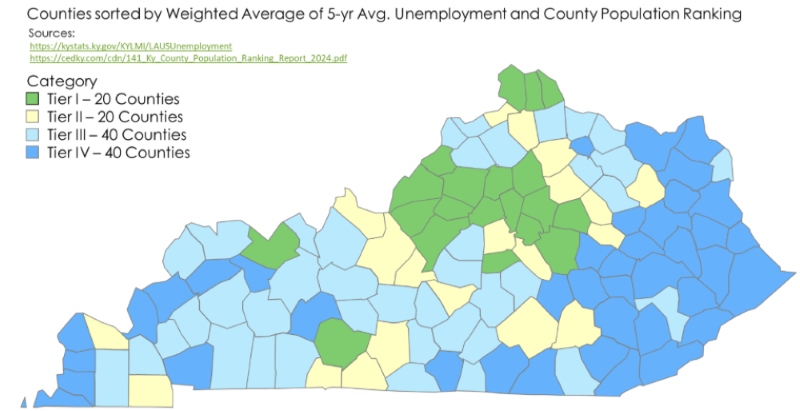
“Other states have made this move and are seeing results,” says Kirk, referring to the multi-tiered systems of South Carolina and Tennessee. “In fact, the states we compete against directly have switched to a four-tier system.”
The four-tier model would also make Kentucky more resilient because the county placement within the tiers is reviewed annually. Counties facing economic shocks would receive a different tier rating, allowing them to take advantage of incentives to build back. For example, if a natural disaster hits or if a major employer leaves an area and unemployment spikes, the county could access additional incentives for job creation in as few as 12 months.
Economic Development Reduces Poverty
One East Kentucky exists to foster economic investment that leads to job creation in the region, helping residents out of poverty. The World Bank believes job creation provides the best opportunity to reduce poverty rates and build up states and countries. Women reinvest 90% of their earnings into their families and communities, so even the creation of a few jobs can spread ripple effects across a region.
Specifically, job creation in Kentucky can reduce the need for government assistance. Kentucky is one of seven states where more than 25% of the population is on Medicaid. Eastern Kentucky also has high rates for SNAP participation, also known as food stamps. Most Eastern Kentucky counties have SNAP enrollment rates ranging from 20% to 25%, while the state average is 12.9%.
The four-tier system could help Kentucky legislators allocate resources where they are needed most, so that the most vulnerable residents receive job opportunities and the ability to reach a point of financial stability, allowing them to move away from dependency on programs like Medicaid and SNAP.
“The government can support residents living in poverty forever, or it can make short-term investments that will move people off government assistance in the long run,” says Kirk. “A lot of people don’t want to use these programs but have to because there aren’t enough high-quality job opportunities.”
Kentucky Can Become More Competitive and Resilient Now
Kentucky has a chance to improve how it supports our communities by creating opportunities for them to invest in economic development. Job creation, new business investment, and infrastructure improvements can go further than assistance programs. To the legislators meeting in Frankfort, consider a four-tier system to incentivize economic development projects. Vote to make your counties more resilient while building a better future for the commonwealth.
Learn more about the four-tier system to incentivize economic development projects.
More Topics